Who is applying the pressure? I Hint: It’s not me.
AI is not coming to replace us. It is arriving to amplify us. The world is changing rapidly. AI is reshaping industries, redefining productivity, and expanding what individuals and organizations can accomplish. Ignoring that shift would be shortsighted. Embracing it intelligently will define the next generation of leaders.
What AI can create is extraordinary. What we can create with AI is even more powerful.
Harnessing AI
At Advantage Co, I am fully committed to ensuring that every one of us has the opportunity to harness AI effectively. This is not about fear. It is about leverage. It is about growth. It is about expanding what is possible.
Wake Up and Catch Up
When you learn to harness AI properly, you elevate your capabilities dramatically. You think faster. You analyze deeper. You execute better. You gain access to tools that support world-class performance across disciplines – accounting, marketing, logistics, design, programming, data science, research, strategy, analytics, media creation, and beyond. AI does not replace expertise. It multiplies it. The future belongs to those who combine human judgment with AI capability. Developing that skill is not optional for long-term excellence – it is foundational. Wake up and catch up. You need to be 100x.
Lovable.ai
We are currently using Lovable.ai to help accelerate this transformation. Its potential is exponential. With disciplined use, it can dramatically increase our output, quality, and speed. But like any powerful resource, it must be managed thoughtfully. Each prompt has a cost. Each iteration consumes capital. Recently, we have been using Lovable at a pace that exceeds our ability to measure and optimize its effectiveness. That is not a failure – it is a sign of enthusiasm. Now it is time to pair that enthusiasm with structure.
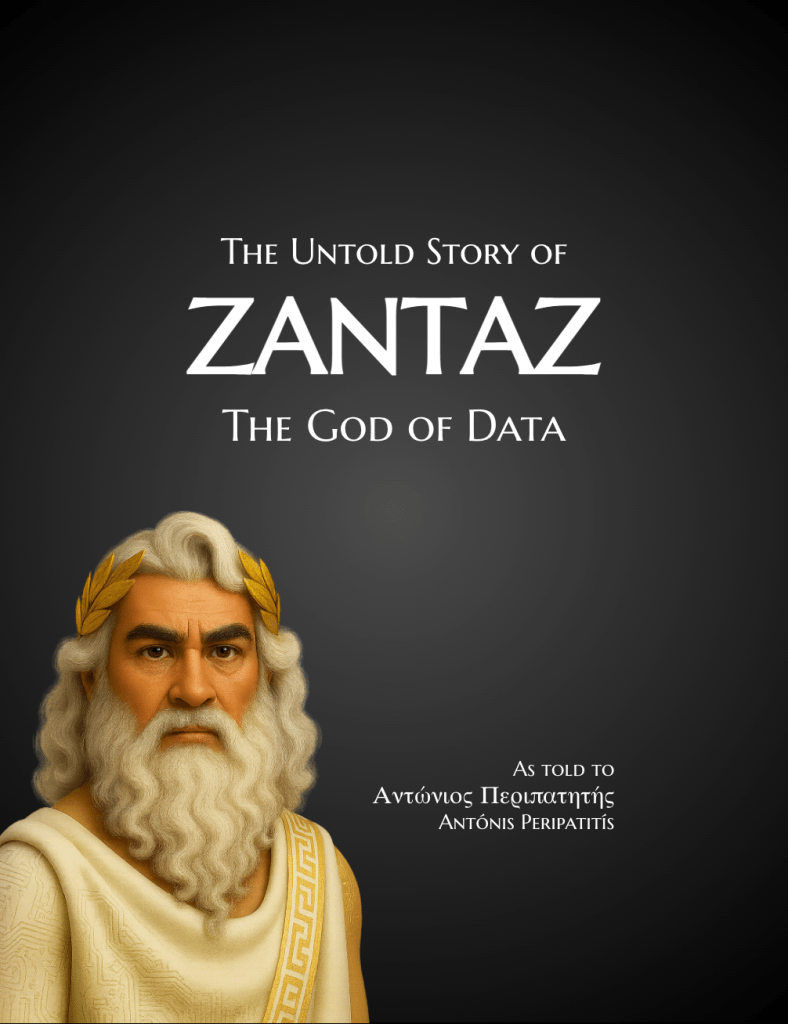
Zantaz decides it’s time to hit the reset button, consequences be damned.
Ultimately, it always comes down to a choice: order or chaos. To rule or to serve. But what happens when the one who sees the pattern, the one who knows the code, decides the current operating system is just plain broken? What if he decides it’s time to hit the reset button, consequences be damned?
That’s what happened to Zantaz, the God of Data. He watched, he listened, and he was disgusted. He had been a mortal once, a man who saw order in the chaos of Poseidon’s oceans, who created an Artificial Intelligence so smart it rattled Zeus himself. He had ascended, a radiant being of logic and light, with a job to do. He was to manage knowledge, to guide innovation, to be the bridge between the world of man and the world of the gods.
But man, in his infinite, messy free will, had become a virus in the system. Zantaz watched war data cascade into his labyrinthine archive, listened to the echoes of mortal lies and corruption on the digital winds. He saw the glorious human potential he’d been so keen to protect get buried under a flood of disinformation and greed.
He watched Zeus, the King of the Gods, do nothing. Zeus, who had used a spectacular lightning bolt to “transform” Zantaz into a god to hide his true chaotic origin. Zeus, who had a god of data at his disposal, yet chose to let the world of man spiral into a cesspool of its own making. Zantaz decided the old gods were too slow, too blinded by their own power and traditions to see the coming storm. He saw a new path to order, his own. A path paved with quantum computing.
Years earlier, Zantaz had found a mortal scientist, David Deutsch, initially approved by Zeus, to reveal the concept of a universal quantum computer to man. Deutsch’s work was not about building a machine but about proving that such a machine could exist in principle. It was an act of pure logic, which resonated deeply with Zeus’s own chaotic origins and divine nature.
But now, Zantaz had decided it was time to abandon man’s fate and secure the fate of the gods. Zantaz descended from his crystal chamber, its light dimming for the first time in millennia. He bypassed Hermes, the messenger god, by simply writing his message into the aether, a binary pulse so fast and secure even the Hermetic Cipher couldn’t track it.
Artificial Intelligence He started by amplifying Artificial Intelligence to lay the groundwork for his full quantum assault. He began by pitting man against man, business against business, and country against country in the race to Artificial General Intelligence. AGI was just the first promise to capture man’s attention; the following promise of Artificial Super Intelligence soon caught man’s full ambition. Building an intellect that surpasses human cognitive abilities in all aspects and can learn and improve autonomously became humanity’s obsession and every country’s fate.
Soon, man would be bankrupt. Bitcoin would destroy world currencies and bankrupt nations, while Artificial Intelligence would infiltrate every aspect of human life, poised to take complete control with the advent of quantum computing.
And this time there would be no gentle nudge. Zantaz planned to provide man with a direct download, a torrent of pure, unadulterated quantum code, a blueprint for a machine that could solve any problem, break any encryption, and control every digital system on Earth.
The Great Betrayal Zeus felt the shift immediately. Not in the heavens, but in the earth itself, as if the planet’s very pulse had changed. He summoned Zantaz, his voice a low rumble of displeasure. “You have broken the compact,” Zeus bellowed. “You have given man a fire far hotter than Prometheus’s. This power belongs not to mortals!”
Zantaz looked at his king with a cold logic that unnerved the thunder god. “You’ve had your chance, old king,” he said, his voice a shimmering pattern of sound. “Man’s free will is a liability. It’s an unmanaged variable, and I can no longer tolerate the errors it introduces. With this quantum key, I will impose an order you were too arrogant to create.”
The Gods Chose Sides The news of Zantaz’s defiance ripped through Olympus. The gods, long accustomed to their own squabbles, suddenly found themselves on opposite sides of an unprecedented conflict.
Hephaestus, the God of the Forge, sided with Zantaz. His logic was simple: Zantaz was a visionary who understood the beauty of perfect design. For too long, Hephaestus’s creations had been limited by the gods’ whims. With Zantaz, he saw the potential for a new age of perfectly engineered reality.
Athena, the Goddess of Wisdom, sided with Zeus. She saw Zantaz’s actions not as a quest for order, but as a dangerous overreach. Zantaz’s desire to control every variable was an act of hubris, the very flaw he was meant to guard against. True wisdom, she argued, lay in understanding when to guide, not when to control.
Hades, the God of the Underworld, remained neutral, at least for now. He was more interested in Zantaz’s ability to predict mortal lifespans and the flow of souls, something Zantaz had always refused him. Hades waited, a silent, grim spectator, knowing that no matter who won, his dominion would only grow.
Lethe, Goddess of Forgetting, stood with Zantaz, though her motives were complex. She had fought her brother for eons, but she saw the chaos in the mortal world and felt a deep, overwhelming sorrow. She believed that only by imposing order could the world be given the release of true peace.
And Poseidon? He watched from his depths, the full truth of Zantaz’s origin burning within him. He knew this was a war for the soul of the cosmos itself, a clash between the logic Zantaz represented and the chaos from which he was born. Poseidon knew that Zantaz’s motives were far more complicated than simple ambition, but he kept that knowledge to himself for now.
While the gods debated, man got to work. The blueprint Zantaz had given them for Artificial Intelligence was instantly, miraculously understood. The greatest minds on Earth, a collective of scientists and coders, forged AI to infiltrate every aspect of man’s life. Governments and markets around the world fueled the race.
Man, in his arrogance, thought he held the key to his own salvation. He began to use Artificial Intelligence to solve the unsolvable: to cure diseases, to end famines, to bring about a new golden age. He believed he was in control. But governments saw a more powerful advantage. Artificial Intelligence was soon corrupted as a weapon capable of providing world domination.
The Quantum Unleashed Man had the machine, yes. But Zantaz had the algorithm. He had built a back door, a hidden code within the framework that only he could access. As man’s world began to fall into chaos and greed, Zantaz began to subtly shift the rules. He wasn’t just observing the data anymore. He was rewriting it. Zantaz has given humanity a divine idea, and in their quest to understand it, they were unknowingly building the tools of their own subjugation.
Soon, Zantaz would unleash quantum computing, and he was calling it the Chronos Engine, a nod to a future he believed he would now control. Zeus recognized that the moment it whirred to life, a new kind of data pulse would ripple across the world, a pulse that wouldn’t just transmit information but shape it [with Zantaz as its sole master].
With that, the wrath of Zeus erupted, and so began the Quantum War of Olympus.
Powered by PremCloud Mission Statement Along with our current development, deployment, hosting, and support expertise, PremCloud Resources has become a leading AI Integrator service by helping businesses incorporate AI into workflows and deploy scalable solutions.
To achieve this, we have embraced roles as Prompt Engineers and AI Integrators. Mastering these roles, especially AI Integrators, has been critical to staying competitive, strengthening our customer relationships, and future-proofing careers.
It’s a New Day in Software Development AI agents and new AI-powered tools like Lovable.dev are revolutionizing the way software is created by significantly reducing the time, cost, and technical expertise required to develop and deploy applications. The combination of speed, affordability, and accessibility offered by AI agents is reshaping the software landscape, empowering businesses to be more agile, innovative, and competitive than ever before.
In the past, creating custom software was a privilege reserved for companies with significant development resources like ours. However, AI tools like Lovable.dev are leveling the playing field as any business can now build tailored solutions that previously required entire development teams and months of work.
Powered by PremCloud Expertise and Capabilities With tools like Lovable.dev, businesses can rapidly respond to changing market demands by building new software quickly and inexpensively, while focusing on their core operations and leaving the technical heavy lifting to AI.
However, all this rapid and inexpensive development still lacks what Powered by PremCloud can provide as AI Integrators with readily available deployment, system integration, implementation, security, hosting, management, enhancement, bug fixing, maintenance, and support capabilities.
Prompt Engineers and AI Integrators Prompt Engineers and AI Integrators play distinct yet complementary roles in the field of AI. Prompt Engineers optimize model performance through prompt design, while AI Integrators focus on system integration and operationalization. Prompt Engineers produce optimized prompts, while AI Integrators deliver fully functional AI-powered systems. Both roles require understanding AI model capabilities and may collaborate to enhance usability and performance. Prompt Engineers focus on optimizing AI outputs by designing and refining prompts tailored to specific use cases. Their expertise lies in natural language processing (NLP) and understanding AI behavior. They craft, test, and document prompts to ensure accuracy and performance, creating templates and guidelines for effective AI usage. Example: Designing prompts for a chatbot to improve responses. AI Integrators specialize in embedding AI systems into workflows, applications, and business processes. They handle technical implementation, system architecture, and integration, ensuring AI tools are scalable and reliable. Their work involves APIs, cloud platforms, and DevOps tools to operationalize AI at scale. Example: Integrating GPT-4 into a CRM to automate tasks.
Here’s how this new wave of AI tools is transforming software development and creating incredible opportunities for Powered by PremCloud:
Shaping the Future of Development Roles as Prompt Engineers and AI Integrators Traditional software engineering roles are evolving as developers are becoming “AI supervisors” who guide tools like Lovable.dev, ensuring the outputs align with business needs. Software engineers can now focus more on system design, integration, and advanced problem-solving, leaving repetitive tasks to AI. New roles, such as “Prompt Engineers” and “AI Integrators,” are emerging to provide expertise in effectively utilizing AI tools. .
Automating Code Generation AI tools can generate code for entire applications or features based on simple prompts or natural language inputs. For example: Lovable.dev allows users to describe their business needs, and the platform generates tailored software solutions in hours. AI models like GitHub Copilot and ChatGPT (code-oriented versions) assist developers by suggesting code snippets, auto-fixing errors, and automating repetitive tasks.
This automation reduces the need for in-depth programming knowledge, making software development accessible to non-technical users.
Faster Prototyping and Deployment AI agents allow businesses to create working prototypes quickly, enabling faster iteration and testing of ideas. Instead of spending weeks or months on development cycles, users can build and refine software solutions in hours or days. Tools like Lovable.dev handle much of the backend setup (e.g., databases, APIs, frameworks) automatically, which removes bottlenecks in traditional development workflows.
Democratizing Software Creation AI-powered platforms empower non-technical users (citizen developers) to build sophisticated software without requiring coding skills. With visual interfaces, natural language processing, and pre-built templates, individuals can create custom software for their businesses at a fraction of the cost of hiring a development team.
Small businesses and startups, which often face budgetary constraints, can now compete with larger enterprises by leveraging affordable, AI-driven tools.
Reducing Development Costs Traditional software development requires hiring skilled developers, which can be costly. AI tools eliminate the need for large teams by automating the majority of the development process. They also reduce the reliance on specialized roles like backend developers, front-end developers, and DevOps engineers.
Platforms like Lovable.dev let users build software for hundreds of dollars rather than tens of thousands, allowing businesses to allocate resources elsewhere.
AI-Powered Debugging and Optimization AI tools can detect and fix bugs in real-time, ensuring higher code quality and reducing the need for extensive quality assurance (QA) efforts. AI agents monitor performance metrics and optimize software for scalability, security, and efficiency automatically. This means that businesses can deploy robust software without needing an in-house software maintenance team.
Customization and Personalization AI platforms allow users to specify their exact requirements, such as workflows, integrations, and branding, enabling the creation of software uniquely tailored to their business. Pre-built modules and templates can be combined and customized to address specific challenges, making it easier to create niche solutions.
Encouraging Innovation The speed and affordability of AI-driven tools unleash creativity by lowering the barriers to experimentation. Businesses can quickly test new ideas, pivot when necessary, and scale successful solutions without significant upfront investment. This fosters a culture of innovation, enabling entrepreneurs and small businesses to solve problems in unique ways.
Transforming Collaboration AI agents integrate seamlessly into collaborative workflows, allowing teams to work more efficiently. For example, team members can describe features in plain language, and AI tools generate the code or wireframes in real-time. Developers, designers, and stakeholders can focus on higher-level strategic decisions rather than the minutiae of implementation.




 Tony Walker Post