
The Stereo Advantage Experience

Teliris_VL_Modular

Over the past thirty five years our Stereo Advantage retail and commercial customers have come to recognize us as their favorite resource for technology in WNY.  Nevertheless, our challenge has always been to stay relevant.  Since 2004, we have been aggressively restructuring and retooling the Stereo Advantage for life after the commoditizing of the consumer electronics business.  We’ve left the carcass of that world for Best Buy, WalMart, Costco, and the internet to fight over.  While they’re busy bloodying each other, we have been hard at work creating a more desirable and sustainable identity to build our future on.  We no longer have retail, wholesale, and commercial sales.  We have the Advantage Experience.  All of our customers, employees, families, suppliers, associates, and community are part of this unique and magical experience.

The old Stereo Advantage provided our retail customers access to entertainment through a well-developed and easily understood matrix of products; while our Commercial Division provided a concierge approach to selling the same entertainment product awkwardly positioned for business use.  Audio/Video provided a recognizable banner for product choices, and it led to a revolution in retail.  Big Box retailers effectively combined disparate categories into an effective sales environment: blending home appliances with audio/video, car audio, computers, and software.  Today, technology has rendered the old matrix unrecognizable, as it has blurred the lines that conveniently separated the categories that we once sold with simplicity.  Additionally, the mass merchants and internet have compromised the old, easily definable categories, by commoditizing them and eliminating their profitability [rendering retailers such as Circuit City and Best Buy insignificant… and we know what happened to Circuit City].

Just as we ushered in a new era in consumer electronics retail with our Home Theater and SmartLink mall concepts in the 90’s, we are now embarking on yet another game-changing venture.  The new Stereo Advantage provides our retail and commercial customers with the resources necessary for effective technology integration by developing system architecture specific to their needs.  We now provide our customers the components, installation, programming, ongoing support, and service required to maximize the potential and effectiveness of their fully integrated system.

Since 1978, the Stereo Advantage’s challenge has always been to provide the type of product and service that our customers need in an ever-changing world of technology.  Today, it is up to us to integrate computer technology with home entertainment for our customers.  Furthermore, we have to make it universally accessible.  Whether it’s in the living room, office, or online – it’s up to us to seamlessly integrate our customer’s access to all of their information and entertainment resources.  No one is better equipped to provide the myriad of expertise necessary to deliver the whole package.  The Stereo Advantage is indeed the Smart Center.

The new Stereo Advantage offers consumers, businesses, schools, institutions, and the government complete technology integration, security, and entertainment solutions, providing the finest brands, Lifetime Service, and system architecture professionally designed, programmed, and installed by The Smart Squad and Advantage TI.

Advantage TI also offers consumers, businesses, schools, institutions, and the government complete technology integration and video-conferencing solutions, and provides them with the professionally designed system architecture, solutions, programming, installation, and ongoing support, security, and service necessary for effective and extraordinary performance.

This revolution in our industry is just getting started, and the new Stereo Advantage has the opportunity to lead the way.  We are uniquely equipped to facilitate the Advantage Experience for everyone we come in contact with.   Eventually this enabling will go beyond the sales and integration staff at the Stereo Advantage to potentially include every Advantage employee, every former employee, and every jump-site associate.  It’s the Advantage Nation.
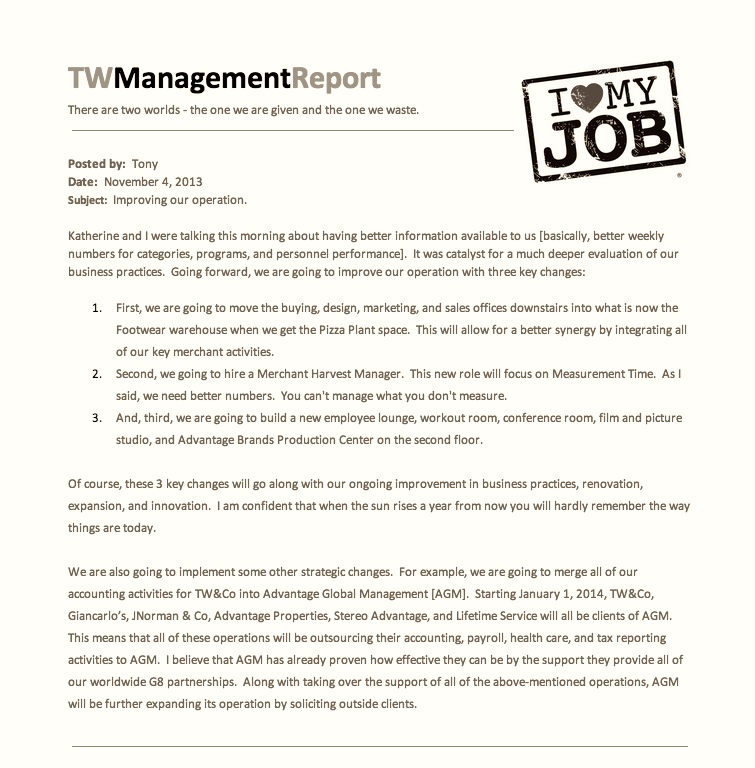
You can’t manage what you don’t measure.

Posted by: Chris Boebel
Date: November 5, 2013

I would be interested in hearing how your approach to measurement has changed over the years.  Do you think it’s gotten more sophisticated, as new tools come along that might assist with analysis, or have you cut it down to the essentials?

Transforming a bunch of data into useful, actionable information is near and dear to my heart.  It’s something I spend a lot of time thinking about, both in terms of personal investigation and as it applies to our retail operations here at Delta Sonic.

In an unrelated matter, I was thinking the other day about how we used to ask people for the last four digits of their phone number.  Long before loyalty occupied the coveted center square on the buzzword bingo board, we were doing it.  Neat!

_________________________________________________

Posted by: Tony
Date: November 8, 2013

You can’t manage what you don’t measure.

I still use the GAP [Gross Profit After Payroll] Report as my main source of information for productivity review.  Every week I skip to the bottom right hand corner to see if we are up or down for the week [as compared to last year], as well as taking a quick glance at our overall YTD number.  Then I start parsing out the departments.

For all the old-timers out there who are still rooting for the Stereo Advantage, the electronics division of the Advantage Co [now named 9Volt for easier reference] is having the biggest increase in GAP ever in the history of the company.  And the best part of it is that they have fully transitioned from Stereo Advantage Retail to Lifetime Service, Advantage Technology Integrators, and iFul Wholesale.

At its peak in 1992, Stereo Advantage Retail did $22M, while this year it will come home with a mere shred of that number.  Back in 1992, we had 240k transactions between Stereo Advantage [140k] and Sneaker Advantage [100k].  5195 Main Street was rocking back then.  LTS, ATI, and iFul, however, are the new engines of the Stereo Advantage these days.  All three are having record breaking years.  It took knocking down the Stereo Advantage building to convince everyone that the good old days were never coming back.  We weren’t going back to the old store, VCR‘s, and the Gusto.  They have found their success at 1955 Wehrle [and at our LTS facility on the West Coast].  It is nothing short of remarkable.

If you review our GAP Reports from the past 25 years, it would give you pretty insightful look at the maturation, success, or demise of just about every undertaking at the Advantage.

Next up in Measurement Time at the Advantage is our Cash Flow Report.  This is, essentially, a weekly Balance Sheet, and it gives us a good look at how we have done over the past 12 months.  It details how our assets and liabilities have grown, been depleted, or been shifted.  It is basically a statement of use and change.  Butch has personally been doing this one since he became CEO in 1997.  It’s his favorite perspective of the company.

Now we are starting our new Merchant Harvest Report which will compliment our GAP Report.  It will detail the progress of our programs and services on a weekly basis.  One of the most crucial Merchant Harvest activities we want to measure is customer referral.

The coin of the realm at the Advantage has always been word of mouth advertising.  As a retailer in the 21st century, we recognize that we must provide our customers with an incredible experience, and that experience must generate revenue.  The currency of that revenue is our customer’s advocacy.  Basically, our customers pay for goods and services with money, but they reward us for an outstanding experience with their referrals.  The sale is not complete until the customer enthusiastically refers us.  Our success depends on it.  I’m sure you remember that one.  It’s something I try to never forget.

The one weak link in our measurement chain is still our inventory analysis.  No matter how much we invest in data, we invariably end up buying by feel.  I don’t know if we will ever change, but, if we don’t, we will never benefit from the amazing analytic resources available today.

As for the onslaught of Big Data, it’s hard not to recognize the value in just about any information on your business activity, but it can be counter-productive if you become a slave to its collection, preparation, delivery, and analysis.  Along with social media, we are learning as we go.

Al in all, I think I personally did a better job of the analysis of our business activity before I used a computer.  Nothing beats that tactile connection to your inventory and customer.  It’s why I still love being a merchant.

Screen Shot 2013-11-05 at 12.52.36 PM

The magic of the wireless router.


When it comes to Technology Performance Evaluation, nothing is more critical in the home or office than the wireless connection.  When I am Skyping in from Naples, I am often frustrated with the inconsistent performance of my conferencing partner’s broadband access, speed, and reliability.  Any technology evaluation, therefore, should begin with the wireless router.

A great wireless router [installed, programmed, and positioned properly] can make a more significant improvement to someone’s technology performance than any other component in the chain.  

I see the wireless router in much the same context as the phono cartridge back in the day.  If you didn’t start with a great signal from your phono cartridge, it really didn’t matter how great your tape deck or speakers were – it just wasn’t going to sound good.  Similarly, without a great broadband connection, you are SOL right out of the gate.  Add in all of the security and use considerations, and the wireless router becomes even more valuable.  But, much like the phono cartridge, very few people understand the value or the actual performance criteria of the wireless router.  I want us to change all that.

We need to focus on wireless routers.  We need to evaluate, recommend, install, and manage the performance of the appropriate wireless routers for all of our customers’ homes and businesses.

__________________________________

Note: The below comments on wireless routers were cobbled together and edited from these three reliable and informative sources  [my apologies to their well-written and thoughtful prose]:
http://www.techradar.com/news/networking/wi-fi/802-11ac-what-you-need-to-know-1059194 by Gary Marshall
http://compnetworking.about.com/od/wirelessrouters/f/bestwifirange.htm by Bradley Mitchell
http://reviews.cnet.com/best-wireless-routers/ by Dong Ngo

Routers are the unsung heroes of the Internet.  The latest wireless router on the market doesn’t generate as much hype as the latest smartphone or tablet, but your router is an absolutely critical part of your home or business network.

Since it connects the rest of your gadgets to one another and the Internet, the wireless router is arguably the most important piece of computer equipment in your home or business.

Not only does it give you wireless access, but it allows the Internet into your private and very vulnerable internal network.  In many users’ homes or business, the router is the primary sentry against security threats.  A good router can help protect against a range of threats from identity to stolen bandwidth [provided the router is secured properly.

Additionally, Wi-Fi routers perform other useful tasks such as allowing you to set up guest access for guests or employees to connect to your wireless network and use your Internet service [without giving them access to resources like files and printers, or you can at least limit that access].  You can also use a router’s Quality of Service [QoS] feature to give priority to the type of network traffic most important to you, be it Voice over IP [VoIP], video, or even file-sharing.

So, although a Wi-Fi router’s main function is delivering Internet [or WAN] access to your private network devices and gives those device wireless access, it can do much more; some can police what your employees or children at home access on the Internet, and just about all can restrict which devices can connect to your network via a feature called MAC filtering.

A wireless router’s antenna technology generally determines its Wi-Fi signal strength and hence its range.  Generally speaking, 802.11g wireless routers offer better Wi-Fi range than comparable 802.11b units due to improved antennas.

In general, wireless routers currently offering the best Wi-Fi signal range, however, are  802.11n [sometimes called “wireless N”] units.  Where standard 802.11b and 802.11g routers contain just one Wi-Fi radio and antenna, wireless N routers contain two or three radios specifically designed to maximize Wi-Fi range.  The actual range and performance of any wireless router, however, varies substantially depending on conditions of the environment such as obstructions and radio interference.

If, however, you thought Wi-Fi couldn’t get much faster than 802.11n, think again.  802.11ac, dubbed 5G Wi-Fi, promises ridiculously fast wireless connections, better range, improved reliability, and improved power consumption.  

802.11ac is the latest evolution of Wi-Fi, and it should be particularly good for gaming and HD video streaming.

So, how does 802.11ac work, does it live up to the hype?

Your 802.11ac speed could break the gigabit barrier.  The fastest current 802.11n Wi-Fi connections max out at around 150Mbps with one antenna, 300Mbps with two, and 450Mbps with three antennas.  802.11ac connections will be roughly three times faster – so that’s 450Mbps, 900Mbps, and 1.3Gbps respectively.

802.11ac routers will use “beamforming” technology.  Wi-Fi is omnidirectional, but 802.11ac routers will be able to use directional transmission and reception technology dubbed “beamforming”.  The router will be able to identify the rough location of the device it’s talking to and strengthen the appropriate antenna(s) accordingly.  The idea is to reduce interference.

802.11ac Wi-Fi uses the 5GHz frequency band.  Older wireless kit uses the 2.4GHz frequency band, which is fairly crowded: your kit is potentially sharing radio frequency with next door’s baby monitor, your cordless phone and even your microwave.  Like high performance 802.11n kit, 802.11ac routers will use the less cluttered 5GHz band where there’s considerably more room for data transmission.  802.11ac hardware will use two kinds of channels in that range: 80GHz ones and 160GHz ones.